Showing posts with label India. Show all posts

Wednesday, April 27, 2011

Daughter of DGCA No. 2 got licence from school with no plane

MUMBAI: They did not have even a single aircraft at their airport base, neither did they have a classroom or a hangar there, but in 2007, for some reason, the Directorate General of Civil Aviation (DGCA) was benevolent enough to grant Raipur-based Touchwood Aviation the approval to start flying training for Commercial Pilot License (CPL) students. 

A month after it started, Rashmi Sharan, the daughter of A K Sharan, joint director general ofDGCA and its number two man, joined the school. Back then, Sharan was the deputy director general (training and licensing), the department which grants approval to flying training organisations. A year after Rashmi got her license and moved out, the school shut down. 

The case of Touchwood Aviation is an intriguing one as it is perhaps the only flying school in Indiato ever get a Flight Training Organisation approval even before it could position an aircraft at its base. It was also allowed to function, though it did not have the mandatory classroom or hangar at its airport base. 

So what are the violations here? 

1. According to Flying Training Circular (No 2/2005) issued by DGCA on May 2, 2005, flying schools/clubs "should have a minimum of three serviceable aircraft", among other requirements, to get an approval to start flying training for CPL students. At any given point of time, if the aircraft fleet falls below three, then the approval for training CPL students will be withdrawn, it states. 

"After the circular came into effect, the DGCA inspected all 16 flying schools in India at that time and flying schools with one or two aircraft scurried to increase their fleet to three," said an aviation source adding that the norms were adhered to in the annual inspections then on. 

When Touchwood Aviation was granted the Flying Training Approval in 2007, this circular, very much in effect — as it is today — was sidelined to grant the approval fraudulently. The proof of violation appears in the hand-written inspection report, dated 24 August 2007 (TOI has a copy) which grants Flight Training Approval to Touchwood. 

It was filed by Mohan Chandran, an official with Aerodrome Standards, Mumbai, after visiting Touchwood's Raipur facility and states that the school is yet to have an aircraft positioned at its base. Said an aviation source: "I do not know of any instance in India, where a flying school got an approval to start training even before it could position the aircraft and build a hangar." 

He added: "Let alone get an approval, the DGCA officials from the flying training department will not even come to inspect the school if the hangar and aircraft are not ready. Getting an approval only comes after site inspection," he added. 

2. How did the DGCA office, find ground facilities "satisfactory", when there was none at the airport base? Apart from the above-mentioned circular, Civil Aviation Requirements (CAR), Section 7, Series D which pertains to approval of flying training instutites also states that a flying school's airport base should mandatorily have aircraft hangar, briefing room, waiting room, etc, for student use. 

But Touchwood Aviation had their office, briefing room, etc, at a place located about 10km from Raipur airport. They did not have any facility at the airport. "Students were ferried to the airport every morning and back in the evening. They would wait on open tarmac through the day for their turn to fly," said a source. 

The issue is not just of inconvenience. Having a briefing room on site is regarded as essential. For instance, before and after every flight, a student undergoes a briefing and a de-briefing session in the classroom. "In a briefing lesson, the flight to be undertaken would be discussed and instructions given so that the teacher and student do not waste time in the cockpit on lessons that can be given when on ground," said an instructor. 

"After a flight, the student is de-briefed and the mistakes and shortcomings are pointed out and instructions given to rectify them," he added. In case of Touchwood, there was no room in the airport for the de-briefing sessions, post flight. 

3. DGCA's flying training department is entrusted with the job of inspecting schools to grant/renew flying training approval. So why did the department waive all the norms for Touchwood? "Since Touchwood had not positioned any aircraft at its base or have a hangar, officials from the DGCA's flying training department refused to inspect the school," said an aviation source. 

Sharan, the then deputy director general (training and licensing), sent Chandran, an official from the aerodrome standards department in Mumbai, to do the Touchwood inspection, the source added. Based on the inspection report filed by Chandran, Touchwood was given an approval for six months, which was later renewed. 

Director General Bharat Bhushan said that he was looking into the case. Manjit Singh, owner of Touchwood Aviation, said that nine students, including Rashmi Sharan, completed their CPL from his school. It shut down in August 2009. Rashmi did her training between September 24, 2007 and October 7, 2008. 

"Airports Authority of India, the owner of Raipur airport, asked Touchwood to pay 13% of the gross turnover since the time of starting school. This made us economically unviable," Singh said about the closure of the school. He confirmed that no hangar space was allotted by AAI at Raipur airport. "All scheduled and periodic maintenance was done in the hangar at Raigarh airport in Chattisgarh," he added. 

Touchwood said that if it gets airport space at rates which are economically viable, it would start operations. But other flying school promoters will vouch that getting a DGCA approval to start a flying training organisation is not an easy task.

Tuesday, April 26, 2011

Adobe India doles out up to 200% bonus

adobeCEO.jpgBANGALORE: At Adobe's India centre, bonuspayouts are not just linked to meeting key result areas (KRAs) or targets, but also to how innovative employees have been through the year. 

This year, the company doled out bonuses up to 200 per cent, a reflection of the firm notching up 200 patent applications to its name over the years, second only to the number of patents applied from its US office. 
The company has 40 per cent of its global research and development talent in India and one of its most profitable global business units, the firm has five in total, is fully managed here. 

"In India, the opportunity for us is talent arbitrage, not cost arbitrage. We choose the best people from the highest ranked colleges like the IITs and other tier I technology schools and make every effort to keep them together," says Jaleel Abdul, senior director, human resources, Adobe Asia-Pacific. 

To keep the flock together, the company is paying top dollar for top-notch talent, 50-60 per cent higher than most other tier I firms. It has promoted 30 per cent of its engineering staff last year and ensured that employees have full ownership of products that are commercialised and are not involved with just a part of the product, as is often the case with global technology firms which has research centres here. 

Employees also get customer feedback on products. Adobe pumps in significant resources to see a patent application through to its end, a process that could take several years and keeps its employees updated through the process. "A patent is a measure of technical excellence and that probably is the biggest high. It is about saying I invented something no one else thought of before," Abdul said. 

"The annual incentive plan or bonus payouts are based on the company's performance and individual performance. Performance is measured with reference to the Leading to Win criteria which includes thought leadership, results leadership, people leadership and personal leadership. The payouts are contingent on differentiated value added by recipients on all four quadrants of Leading to Win criteria. In addition to this, the company also gives out significant special bonuses to employees who work on innovative ideas that get patented," he added. 

The company has seen a significant increase in the number of patents it has been applying for every year. A growing headcount is also lifting the number of the patent filings, now at almost one every year. 
At a time when most technology firms have been a grappling with huge churn, Adobe says attrition has been in single digits and one sign of employees staying with the company for long periods is that today is because large part of its leadership team has come through the campus route. 

Adobe has also increased hiring significantly this year. It has 1,800 employees and has been increasing headcount at 15-17 per cent a year in the past. In the first three months of this year the company has already hired 350 people.

Tuesday, April 19, 2011

UAE to restrict access to BlackBerry email service

NEW DELHI: Research In Motion (RIM) on Sunday confirmed that access to BlackBerry's encrypted email service would be restricted in UAE. According to proposed guidelines only the organizations with 20 or more subscription ofBlackBerry Enterprise Server will be allowed access to BlackBerry's encrypted email services. 

The company said that move has been mandated by new government policies in UAE that require all smartphone vendors not to provide encrypted email service to individual customers. 

"The Telecommunications Regulatory Authority (of UAE) has confirmed to RIM that any potential policy regarding enterprise services in the UAE would be an industry-wide policy applying equally to all enterprise solution providers," the company said in an emailed statesman. 

Last week when the reports of restriction on encrypted email services surfaced, UAE officials had denied any such plans. 

RIM is reportedly negotiating with India over government access to its enterprise servers. India claims that lack of government access to encrypted Blackberry services is a threat to national security. In the past RIM had said that each enterprise maintained its own encryption keys for its account with BlackBerry. Its officials claimed that providing this key to government was not possible for RIM. 

A few days ago when asked about RIM's negotiations with India over security issue, the company president, Mike Lazaridis, stormed out of a BBC show. He claimed that the questions were "unfair".


Friday, April 1, 2011

Extraminds.com (Free Education)

Extraminds.com is a Social networking plus educational website where they provide free education for all the students covering all classes as per CBSE. This is  a very unique opportunity for the students of all classes where they can find their study solutions with video tutorials. As we all know Facebook.com its also social site where we can make our personal Account & do chat,messaging,email,like,comment & share. There we can make our personal Account. Its same like facebook but plus point is they provide free education for all the students for all the classes. This  information is for all the students.

Friday, March 25, 2011

Ponting predicts India will beat Pakistan in the semifinals

AHMEDABAD: Australian captain Ricky Pontingon Thursday predicted that India would beatPakistan in the World Cup semifinal and Mahendra Singh Dhoni's men are the strong favourites to win the coveted title after a gap of 28 years. 
"India played well as a team today and deserved victory. Today we were not good enough (to win). Going forward they will be pretty hard to beat. They will beat Pakistan in the semifinal and go on to win the World Cup now," Ponting said at the post-match press conference after Australia were knocked out of the World Cup by India. 

"India have a very good batting line-up. We played very competitive cricket tonight but I'm disappointed with the two successive losses (against Pakistan in their last league game and today against India)," he said after his side's five-wicket loss in a high-octane World Cup quarterfinal. 

He said he would not be playing in the next World Cup but ruled out quitting one-day cricket. 

"I am not quitting one-day cricket but this is probably my last World Cup game. I will be happy to look back after retirement that I made a century in my last innings in the World Cup," Ponting said

He also said that the talk of the end of an era in Australian cricket was misplaced. 

"It's a bit premature to say it was the end of an era for Australian cricket, it was a pretty good game tonight. I do not think we were far away from winning the game against a very good Indian team on their home soil. I think it's a bit too early to say it's the end of an era," said Ponting. 

Ponting said his side had the chances to win the game and they were devastated by the loss. 

"We had great expectations from the game. We were a well organized group. We are devastated. We found it difficult to get momentum. Not performing at critical moments cost us the game. We did not grab our opportunities," he said. 

"We were 15 to 20 runs short with the bat. 250-260 was a good total but we lost wickets at bad time and never got the momentum going. We did not execute the plans properly," said the 36-year-old Tasmanian who scored a superb 104 after having struggled in the earlier part of the tournament. 

The Australian captain felt the schedule of the tournament could have been spread out better but said that that cannot be an excuse for his side's crashing out in the quarterfinals. 

"The schedule did not help us. But that cannot be put as an excuse for the loss. Over the last ten days my team has played four games. It would have been nice to have them (games) evenly spread out," he said. 

He sympathised with his key fast bowler Brett Lee who had made a great effort to get back into the team after a 14-month injury lay-off. 

"Brett has given a lot for Australian cricket during his entire career and at times coming back after big injuries. He will be shattered as he has worked very hard to get here," he said.

Thursday, March 24, 2011

Ind vs Aus: India on the edge as Men in Blue face Australia

AHMEDABAD: This is it. Hold your breath whenIndia take on Australia on Thursday, for there will be no second chances. The biggest stage, and the crucial moment, has arrived. 


Reputations are at stake for MS Dhoni and his beleaguered counterpart Ricky Ponting. India lost to Australia in the 2003 World Cup final and endured an awful campaign in 2007, but the scales have tilted since. This isn't the invincible Australia of old. Rather than a sublime and uplifting battle between two powerhouses of the international game, current form indicates this second quarterfinal might be more of a scrap. 

Neither side has been awe-inspiring in the build-up to this moment. Both have obvious chinks in the armour just waiting to be exploited, and both need to shed the blow-hot, blow-cold approach which has characterized their campaign so far. 

Then there's the enormous pressure breathing down their necks, especially Dhoni's men. India are playing at home and millions expect nothing less than victory. The backlash, in case of defeat, will be painful. Australia have dominated this stage for so long that this bunch of players wouldn't like to be remembered as children of a lesser god. Whichever team can raise its game now will go through to meet Pakistan. 

As many as six players in Dhoni's current squad were losing finalists in 2003 and will be looking to make amends. It's a great opportunity to settle an old score. Yet, making a statement of intent might not be easy, even though the Motera is expected to be dry and spin-friendly. India's bowling, apart from Zaheer Khan, has been ordinary. Time and again, they have faltered in the Batting Powerplay. Even the middle-order has collapsed twice. Australia's pacers can be a handful. Can the sight of a familiar opponent get the competitive juices flowing? 

The issue of Virender Sehwag's fitness is another complication the team could have done without. The opener is struggling with a troublesome knee and Dhoni said a call on his availability would be taken in the morning. Sehwag, however, spent a lot of time at the nets fielding and batting, and seems more likely to play than not. 

The Australians too have been anything but impressive. Ponting's time seems to be running out. His form and confidence is under the scanner and his fierce temper has shown through. Controversy and bad blood seems to be hounding the Aussies and they've been forced to maintain a quieter profile. The loss to Pakistan meant drawing the curtains on a 34-game unbeaten streak in this tournament and this loss of aura is a boost for opponents. 

Will this be India's turn to deliver a knockout blow?

Monday, March 14, 2011

India world's No. 1 arms importer

NEW DELHI: India has emerged as the largest arms importer in the world, overtaking even China, claims a report by a Swedish think-tank. 

The Stockholm International Peace Research Institute (Sipri), in its report to be released on Monday, said India accounted for 9% of allinternational arms imports between 2006-2010, making it the world`s largest weapons importer. 

China was relegated to second place, notching 6% of global arms imports, Siemon Wezeman of Sipri told international news agencies. The US remains the largest arms exporter, followed by Russia and Germany, as per the report. 

This is not the first time that India has topped such an international list. As reported by TOI earlier, US Congressional Research Service's reports on conventional arms transfers placed India right at the top in 2004 and 2005, with agreements worth $5.7 billion and $5.4 billion respectively. 

China, however, hides more than what it reveals. Beijing`s military expenditure figures as well as its acquisition of advanced weapon systems and platforms remain shrouded behind a thick iron curtain, which global monitors cannot penetrate easily. 

Unlike India, China has rapidly built a robust domestic defence-industrial base (DIB) over the last couple of decades, which often also revels in reverse-engineering top-of-the-line weapon systems developed by other countries. 

"China does spend staggering amounts in importing weapons from countries like Russia, often displacing even India as Russia`s largest defence customer,`` said an Indian defence official. 

If India`s defence budget for the coming fiscal is pegged at $36 billion, China is "officially`` going to spend $91.5 billion. Experts, however, reckon that it will spend almost twice the amount on its 2.5-million strong People`s Liberation Army. 

But all this does not take away from the fact that India has certainly cranked up the modernization of its armed forces since the 1999 Kargil conflict, inking arms deals worth over $50 billion since then, the majority of them with foreign armament majors from Russia, Israel, France, UK and now, increasingly the US, as tracked by TOI. 

With limited private sector participation, coupled with DRDO, eight defence PSUs and 39 ordnance factories largely failing to deliver, India remains saddled with a poor DIB. So, with the armed forces continuing to import almost 70% of their requirements from abroad, India will remain a big time arms importer for the foreseeable future. 

There are several mega defence projects in the pipeline, which will see also tie-ups with foreign companies for technology transfer for indigenous production. The gigantic $10.4 billion project to acquire 126 medium multi-role combat aircraft, for instance, is in the final lap now, with commercial negotiations slated to soon begin with the eventual winner among the six aviation majors in contention. 

Two major deals on the verge of being inked are the over $2.1 billion deal for the Mirage-2000 fighter upgrade with France and the $4.1-billion one for 10 C-17 Globemaster-III strategic airlift aircraft with the US. India, incidentally, is likely to order another six C-17s after the first 10. 

Then, the armed forces are looking to induct over 600 helicopters, ranging from VVIP and heavy-lift to attack and light utility ones, many of them from abroad, for well over Rs 20,000 crore. 

Navy, in turn, is all worked up about launching its Project-75India to acquire six new-generation stealth submarines as soon as possible. The submarines, equipped with tube-launched missiles for land-attack capabilities and air-independent propulsion (AIP) to enhance operational capabilities, will be built in a project worth over Rs 50,000 crore. 

The "granny`` of all defence projects will be the joint Indo-Russian project to develop the Sukhoi T-50 fifth-generation fighter aircraft. With IAF looking to induct 250 to 300 of these stealth fighters from 2020 onwards, India will eventually spend over $35 billion on this project alone.

Wednesday, March 9, 2011

Indian warships in Pak navy ad

ISLAMABAD: In an embarrassing goof-up , an advertisement issued by the Pakistan navy on Tuesday for a multinational exercise prominently featured images of Indian Navy warships even though India is not among the participating countries. 

The full-page advertisement for the Aman-11 exercise in the Arabian Sea, which appeared in The Nation and Nawa-e-Waqt newspapers, featured photographs of Indian Navy's Delhi, Godavari and Talwar-class warships. The insert also featured images of US warships under the slogan: "Together for peace" . 

Warships, aircraft, Special Forces and representatives from 39 countries are participating in the exercises for fostering peace in the region and enhancing cooperation to counter maritime threats like piracy. 

Within hours of the advertisement being posted on websites of newspapers, blogger Shahid Saeed posted the original image of American and Indian warships from the Malabar 2010 exercise that was used in the advertisement . There was no official word from the Pakistan Navy. 

Blooper in official advertisements is something that unites the neighbours, though. In March last year, an advertisement issued by the police in Pakistan's Punjab province carried the logo of India's Punjab police. In January last year, an Indian government advertisement featured former Pakistan Air Force chief Tanvir Ahmed alongside PM Manmohan Singh and Kapil Dev.

Tuesday, March 8, 2011

SIM cards new national security risk, warns MHA

NEW DELHI: Did you ever imagine that your innocent looking mobile SIM card could be a major threat to national security? It now turns out that many of the SIM cards being used by nearly 700 million mobile users in the country may have malevolent embedded software, which has put India's security agencies on tenterhooks. 

This new national security risk emerging out of the import of SIM cards, carrying embedded software for mobile phones, has alarmed the home ministry (MHA) and it intends to ask the telecom industry to replace all such imported SIMs in the country with locally manufactured ones at their own cost. 

According to a government source, only 30% of the total volume of SIM cards are imported at present, though even this figure will now be subjected to a formal evaluation of installed capacity. 

The fear is that the embedded software turns the SIM card into a minicomputer, which can be a cause of abuse. The MHA feels that although domestic telecom service providers personalize the SIMs, which reduces the risk, the security threat gets aggravated as telcos then provide the encryption keys to the manufacturing facility outside India, as part of standard trade practice. 

The security agencies are proposing that only blank SIM cards be allowed for import and the personalization process be done entirely by domestic firms. Consultations are on with the DoT to establish the lead time required to create such capacity and indicate a specific time frame to the MHA. 

However, since this can only reduce vulnerability of future imports, MHA wants the industry to replace all existing SIMs at its own cost. The MHA also wants the DoT to weed out all fake and duplicate IMEI numbers, indicating that its earlier crackdowns have not been entirely successful.

Monday, March 7, 2011

India win toss, elect to bowl against Ireland


Indian captain Mahendra Singh Dhoni won the toss and elected to bowl against Ireland in their Group B match of the cricket World Cup at the M Chinnaswamy Stadium in Bangalore on Sunday
The hosts can not treat the Irish team as minnows considering Ireland's impressive win against England on Wednesday in which Kevin O'Brien had scored the fasted century of the World Cup using just 50 balls to reach there.
India have more reasons to worry about as their opener Virender Sehwag is nursing a rib injury that he had acquired during practice ahead of the England game, which had ended in a tie.
India have fielded the same team which tied its previous match against England.

Ireland have made one change to the side which upstaged England, bringing in Andrew White for Gary Wilson.

Teams:

India: Mahendra Singh Dhoni (c), Sachin Tendulkar, Virender Sehwag, Gautam Gambhir, Virat Kohli, Yuvraj Singh, Yusuf Pathan, Harbhajan Singh, Piyush Chawla, Zaheer Khan, Munaf Patel.

Ireland: William Porterfield (c), P Stirling, Ed Joyce, Niall O'Brien, Andrew White, A Cusack, Kevin O'Brien, J Mooney, D Johnston, George Dockrell, W Rankin.


Tuesday, March 1, 2011

Sachin and India: Tale of two majestic growth stories

The 1990s was a time of awakening for the Indian economy. It was a time of VCRs, Walkmans and Maruti-800s. It was an age when still cameras needed roll film, there was only one Bachchan, Air India was still making money and the gift-toting NRI uncle was treated as a VIP. It was also the era of Sachin Ramesh Tendulkar.

If Manmohan Singh broke the shackles of the nation's economy in 1991, the same happened on the cricket field through the bulky bat of a 5-foot-5 batsman with a squeaky voice and the most vicious on-drive ever. Tendulkar, with his middle-class upbringing in suburban Mumbai's Sahitya Sahawas, went where no man had gone before.

As our economy began its majestic rise, the nation saw hope in this genius from Indian cricket's capital. Finally, we had a player who went after the impossible. If Gavaskar was the man who staved off defeat, Tendulkar was the prodigy who always eyed victory... he was the competitor who gave the opposition a taste of their own medicine. Cowed down for years, it was time for India to hit back, whether in business or on the cricket pitch — and hit back we did, with aplomb.

In Sachin, Indians saw the aggression of Richards, the technique of Gavaskar, and the heart of Kapil. And when he entertained them, they forgot their troubles, rooting for the "little bundle of dynamite" who made 'blond bombers' look pedestrian. For Sachin, failure was not an option. Old women prayed for him, executives skipped office, and an entire generation dreamt of becoming cricketers. While the 'Little Champion' was at the crease, there was always hope.

Carrying a super-heavy bat, synonymous with the burden of the nation he bore, he had his days on the pitch and as had our roaring economy. If there was desert storm in Sharjah where he single-handedly destroyed the Australian attack), then there was also the sensex crossing the 10,000 mark. 'Sensexational' said one TOI headline, 'Batman Begins' said another. Our forex reserves went up at the same speed with which 'Tendlya' accumulated hundreds. "We lost to Sachin," Aussie captain Steve Waugh once said.

As India's software engineers began putting their stamp on global markets, a resurgent Team India, inspired by Sachin, started doing something they had rarely done before — winning abroad. Once that barrier was breached, there was no looking back.

Of course, it's not just his batting talent that has always been revered (or the fact that he turns the ball more than any Indian spinner)...but also the humility that this magician brings to the turf. This is the same person who sits atop a mountain of advertizing cash. Remember the commercial where every kid wears a Sachin mask, or the one where the soundtrack screams 'Sachin aala re', echoing the thoughts of millions of Indians. Even now, he seems omnipresent.

Through the years, as India's economy gained momentum, the economy of the Tendulkar household didn't do too badly either. Sachin's pathbreaking multi-crore deal with WorldTel made him cricket's first millionaire. Not that he let it affect his game. He stayed in the zone, the monk with the Ferrari.

Now, 20 years after the reforms that transformed our sleeping economy into a crouching tiger, and ages after an enthusiastic boy convinced his skipper to let him open the innings, we are one of the two fastest growing big economies in the world, while that teen with the squeaky voice has become a legend. Still, when he goes out to bat, India holds its breath.

Batting for posterity
• Sachin has scored highest aggregate runs and maximum 100s and 50s in both Tests and ODIs game. He also holds the record of most 90s in ODI, getting out 18 times in the 90s
• Has hit 1,943 ODI and 1,892 Test fours, which is the highest for any batsman
• Played 177 Tests and 446 ODIs, the highest by any player
• His 21-year, 71-day career is the longest among current players as well as cricketers who have played more than 100 Tests
• Is the only player to score more than 1000 Test runs six times and 1000 ODI runs seven times in a calendar year
• In the 2002-03 ICC World Cup, he scored 673 runs, the highest for any player
• In 1998, he scored 1,894 runs in ODIs, the highest number of runs scored by any batsman in a calendar year
• Has scored 9 hundreds against Australia, the highest against any team by a single batsman
• Has scored 1,778 runs in the 42 innings he has played at the Sharjah Cricket Association Stadium in UAE, his highest on any ground
• Has faced 778 different bowlers, of whom 528 have failed to get him out even once
• Of the 250 bowlers who managed to get him out, Brett Lee has been the most successful, scalping him 14 times
• Sachin has scored 600 runs off Muralitharan, his highest off any bowler
• Has faced 47,788 balls in international cricket. This is equal to 7,965 overs
• In his over 21-year career, he has spent 1,145 hours on t


Saturday, February 26, 2011

India vs England: Going down memory lane

The very first game of the World Cup was played between India and England, back in 1975 at Lord's. Since then, this rivalry has grown into a fascinating duel, with India enjoying a upper hand in recent times. We look at four games between the two sides that are worth remembering for years to come.. 

When Freddie took off his shirt... 
The teams went into the final game with India leading 3-2. This match, at the Wankhede in Mumbai, provided the fitting climax as England eked out a thrilling five-run win to draw the series 3-3. England made 255 based on opener Marcus Trescothick's 95. They looked like making much more at 153-2, but collapsed, with Harbhajan Singhpicking up a five-for. Sourav Ganguly (80) led India's chase, but Andrew Flintoff (3-380 won it for England. To rub salt into India's wounds, Flintoff took off his shirt and ran around the ground with his teammates in jubilation. 
Feb 3, 2002 at Wankhede Stadium, Mumbai

Brief scores: England 255 in 49.1 overs (M Trescothick 95, N Hussain 41, A Flintoff 40; Harbhajan 5-43) beat India 250 in 49.5 overs (S Ganguly 80; A Flintoff 3-38) by five runs. 

When Aleem Dar did India in 

It was the decider of the NatWest series, which had gone right down to the wire at 3-3 till that point. At Lord's, however, everything went wrong for India. England, expectedly, prepared a fast and bouncy wicket and bowled out India for 187. The game, unfortunately, was spoiled by Pakistani umpire Aleem Dar's folly in judging Sachin Tendulkarout caught behind off Flintoff when television replays showed that the ball had brushed the batsman's shoulder. 

Sept 8, 2007 at Lord's 

Brief Scores: India 187 in 47.3 overs (MS Dhoni 50; A Flintoff 3-45, A Mascarenhas 3-23) lost to England 188-3 in 36.2 overs (K Pietersen 71 not out, P Collingwood 64). 

The Lord at Lord's 

It was probably the second most impactful win for India after the 1983 World Cup triumph. The Natwest tri-series final looked like England's for the taking after Nasser Hussain & Co made 325 for five. With the top order in the hut, all hope looked lost at 146-5, before Yuvraj Singh and Mohammad Kaif scripted a sensational turnaround with a 121-run partnership. The most abiding memory though was Sourav Ganguly twirling his shirt on the Lord's balcony. 

July 13, 2002 at Lord's 

Brief scores: England 325-5 in 50 overs (M Trescothick 109, N Hussain 115; Z Khan 3-62) lost to India 326-8 in 49.3 overs (M Kaif 87, Yuvraj 69, S Ganguly 60, V Sehwag 45) by two wickets. 

The Nehra sixer 

In a must-win game for India, Ashish Nehra produced perhaps the best-ever spell delivered by an Indian fast bowler. Playing with a badly damaged knee, Nehra ran through the English batting line-up on a seaming Durban pitch. In between, the charged up pacer had a banana and threw up instantly! The other thing worth remembering from this game is Sachin Tendulkar's pulled six off seamer Andy Caddick.


World Cup: Bangladesh beat Ireland by 27 runs

MIRPUR: Bangladesh spinners, so ineffective against India, rediscovered their magical touch on Friday to fashion an exciting 27-run win over Ireland in a low-scoring Group B match of the 2011 World Cup at the Sher-e-Bangla National Stadium here. 

It was a torturous win for Bangladesh, who were bowled out for a meagre 205 after frittering away a blistering start, but it kept the co-hosts firmly in contention for a berth in the knock-out stage. 
Ireland batsmen, who had no inkling about how to play the play the turning ball, were easy pickings for wily Bangla spinners, who bundled them out for 178 in 45 overs with some help from pacer Shafiul Islam, who passed a fitness test in the morning. Shafiul, who grabbed three of the last four Ireland wickets, finished with figures of 4/21. 

Ironically, it was part-timer Mohammad Ashraful's innocuous off-spin that turned the match Bangladesh's way after frontline spinners Abdur Razzak, skipper Shakib Al Hasan made the initial breakthroughs. Playing in place of Mahmudullah, Ashraful, who had earlier played a horrendous shot to get out cheaply, made amends by dismissing the experienced duo of Ed Joyce (16) and Andrew White (10), fooling both with a clever variation of pace and trajectory. 

Ireland's hopes of sneaking an improbable win under the lights rested on the O'Brien brothers, Niall and Kevin. While Niall, looked more compact of the two, Kevin showed he had the big shots. They contributed 38 and 37, respectively, but threw away their wickets after having played themselves in. 

Joyce's soft dismissal to Ashraful showed why he failed to win an England Test cap and skipper William Porterfield's unshakable faith in gangly pacer Boyd Rankin was hard to fathom, particularly as he struggled with both length and direction right through the Bangladesh innings. 

In the end, it was a crucial 23-run ninth-wicket partnership between Naeem and Razzak, that made all the difference. Bangladesh, who got off to a rousing start through their openers Tamim Iqbal and Imrul Kayes, ought to have posted a total in excess of 250 after Shakib elected to bat. 

Tamim, who top-scored with 70 against India, looked to be in super touch as he cut, drove and flicked Rankin and Trent Johnston to log 44 off 43 balls that won him the Man-of-the-Match award. With Kayes also joining the party with a brilliantly square-driven boundary off Rankin, Bangladesh raced to 50 off 5.4 overs. 

A smart leg-side stumping off a wide, effected by wicketkeeper Niall O'Brien to send Kayes packing, and Joyce scoring a direct hit from mid-off to catch Junaid Siddique short of the crease, brought Ireland back in the game. 

Alarm bells started ringing in the Bangla dressing room when Tamim played a lazy cut off Andre Botha shortly afterward and was held by Porterfield at point. Shakib began with a flourish, but refused to mix caution with aggression despite being dropped by Porterfield at point off Rankin when he was on 15. He paid the price for pushing early at a Botha delivery as the ball popped up for nicely for the bowler to hold. 

Mushfiqur Rahim and Rokibul Hasan rebuilt the Bangladesh innings with a sensible 61-run partnership for the fifth wicket before the former had a rush of blood and departed, top-edging an intended sweep off left-arm spinner George Dockrell. And with Mohammad Ashraful departing much in the same fashion two overs later, early 'dinner' was on cards. However, Roqibul (38), Naeem (29) and Razzak (11) ensured that Bangladesh spinners had something to bowl at.

Saturday, February 19, 2011

Revenge is foremost on India's mind


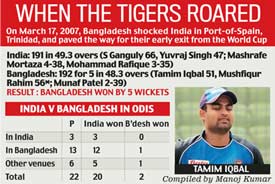
It's revenge time for India. The unexpected defeat at the hands of Bangladesh during the 2007 World Cup is still fresh in the minds of most Indian players and avenging that loss will be on top of their must-do agenda as they clash with the co-hosts in the opening match of the World Cup in Dhaka on Saturday.

That defeat was instrumental in sending India out of the tournament in the first round itself and the hurt can still be felt in the Indian camp. Captain Mahendra Singh Dhoni just doesn't want to talk about it. "Never even thought about it because we don't want to repeat what happened in 2007," he said on the eve of the big game that millions of people are looking forward to. In several ways, the result of the day-night encounter at the Sher-e-Bangla National Stadium could set the tone for the 14-nation, 45-day tournament. If it turns out to be a closely fought encounter, it will be a good advertisement for the 50-over format - which some people feel is under threat from Twenty20 - and will make investors/advertisers and some others smile.
Already, an anonymous punter has put a bet of £82,000 bet - the biggest ever laid on a one-day game - with a London bookmaker on India winning the World Cup. But Dhoni would again not like to think about it, otherwise it would add to the pressure on him. Bangladesh have managed to eke out only two wins in 22 matches against India in more than 22 years of bilateral ODI history, but the one they managed on March 17, 2007, was the most telling. And when Dhoni, who failed to score in that game but took three catches, goes out for the toss, his mind would surely go back to that defeat.
He may have given a new name to pressure, "added responsibility", but he can't just shrug it away from his mind. One consolation for India is that pacer Mashrafe Mortaza, who bagged four wickets and was man of the match in that game, is not in the team. Seven of the 11 players who lost that game are still in the Indian team and would be itching to avenge that embarrassment.
Interestingly, India and Bangladesh could be in different mindsets as they returned contrasting results just before the World Cup. While India lost the five-match ODI series 2-3 in South Africa last month, Bangladesh blanked New Zealand 4-0 at home and then thrashed Zimbabwe 3-1 in December and would be high on confidence.
For India, pace spearhead Zaheer Khan is suspected to be a doubtful starter due to an injury. But Dhoni was confident he would play. "Zaheer is fit as of now. I have not spoken to the physio. If there is something, I will let you know," he said. Left-armer Zaheer bowled at the nets on Friday evening, but did not go full throttle. Maybe, Dhoni wants to preserve him for the more important matches coming ahead. Maybe, the bowler is still not 100 per cent match fit. The answers will be known on Saturday afternoon when Dhoni exchanges the team sheets with his Bangladesh counterpart Shakib Al Hasan at the toss.
Dhoni said spinners could play a big role in the tournament as pitches in India, Bangladesh and Sri Lanka largely support slow bowlers. Bangladesh too would depend largely on spinners, who happen to be their strength, especially on home turf.
The India skipper too acknowledged this. "All three Bangladesh spinners are good. They have got two good part-timers who can bowl off-spin and leg-spin. It's a good side. In the sub-continent, they rely a lot on their spinners because here they get more assistance than anywhere else," he said.
Shakib was gung ho about Bangladesh's prospects. "Our bowlers are in good form, the batsmen have been doing their job and our fielding has improved a lot," he said, looking confident.
"This tournament is not only about playing India. We have six league matches to play and we have to perform in all of them. If we get our basics right, we will do well."
Bangladesh will no doubt receive wholehearted support from vociferous home fans. But the experienced Indian players are not new to playing and winning in adverse conditions. And they are expected to do the same on Saturday.

Friday, February 11, 2011

Pick of the week: ONGC

Broking firm Edelweiss has picked up Oil &Natural Gas Corpn (ONGC) as Edelweiss Star. It has recommended `Buy` with the target price of Rs 1,360. Broking firm has given investment rationale and technical view for investing in the stock. The same are as below:

Investment rationale:
Global crude demand likely to increase on global recovery. Moreover energy consumption in India from natural gas(currently ~9% due to shortage of gas) is set to rise due to production increase from 132mmscmd in FY10 to around 230 mmscmd in FY12E. Based on the demand of gas for power and fertilizers, we believe that an increase in thegas supplies can be easily absorbed by the country. In fact, we believe that India may have an appetite for more gas supplies, as the country’s GDP grows above 8.0% CAGR in the next decade which offers serious opportunities in oil & gas sector.

ONGC`s (Q,N,C,F)* earnings will be positively correlated to the increase in crude prices, as an increasing proportion of its international revenues (through OVL in a deregulated environment) will lead to higher realisations on crude. Also, OVL will be the major driver for volumes in the future and is also currently scaling up its production assets aggressively.

Significant APM gas price hike at one go is definitely positive for ONGC. This is a significant positive for the company and will support the substantial capital investmentsby it. Further, ONGC`s current exploration acreage offers significant opportunities for increase in reserves. Further, we are enthused by ONGC`s asset, new projects, and potential exploration upsides. However, till clear subsidy sharing mechanism emerges, uncertainty may prevail.

Investment Risks

Lower-than-expected crude prices will impact the company`s crude realizations and earnings. Additionally, the company`s net realizations also depend on the upstream (ONGC) subsidy sharing.

Higher-than-expected decline rates in its existing matured assets could impact its production, going forward.

ONGC has assets in countries like Sudan and Syria, which face geo-political risks. Therefore, any unfavorable incident could impact production.

Outlook and Valuations
Our outlook on ONGC has improved due to increase in gross crude realisation and recent correction in stock price. On our FY11E and FY12E EPS estimate of Rs. 105 and 129, the stock is currently trading at a P/E of 11.3x and EV/EBITDA of 4.9x on FY11E basis and at a P/E of 9.2x, and EV/EBITDA of 4.3x on FY12E basis. Given these attractive valuations and its growth prospects, we believe the stock offers upside potential in the near term.

Source: Myiris news - Live News - Pick of the week: ONGC

Thursday, February 10, 2011

Coming soon: India's biggest mosque in Kerala


India's largest mosque is set to come up near Kozhikode in Kerala, covering an area of 12 acres on the sprawling 'Knowledge City' complex of Islamic religious and Cultural Jamia Markazu Ssaquafathi Ssunniyya.

Estimated to cost Rs 40 crore for construction, the mosque would be able to accommodate 25,000 people for prayer at a time, Markazu sources said.

The Jama Masjid in Delhi is the largest mosque in India currently.

Source: Coming soon: India's biggest mosque in Kerala - Rediff.com News

Tuesday, February 8, 2011

‘Study of all power plants essential’ - Mumbai - DNA

Only the combined study of all the proposed power projects on the Konkan coastal belt, will give the real picture of the possible impact on the environmental of these plants, says the Bombay Natural History Society (BNHS).

The 200-km-long Konkan coastline is expected to have around 15 thermal power plants, with a capacity of around 23,000MW. Adding to that will be the much controversial Jaitapur Nuclear Power Project, which has capacity of 9,900MW.

“This is not the question of one nuclear power plant. When you have such a huge number of projects coming up, you have to study the impact in totality. If you see the proposed plans on map, there is no open space available in the belt of 200km from Dabhol to Sindhudurg. Plus, all these projects will be releasing hot water in to the sea, which will increase the seawater temperature,” said Dr Deepak Apte, deputy director, conservation.

He added that the rising temperature does alter the present ecosystem and increase the number of newer species. “It is good for some species, but not for others. Therefore, we feel that all the projects should be studied in a combined manner to reach a conclusion,” said Apte, adding that had there been a single project, then an isolated study could have helped.

BNHS also released its interim report on the impact of oil spill, which took place after the collision between two vessels namely MSC Chitra and Khalijia in August 2010.

The report claims that the spill has harmed the mangroves spread over the 1,273.24-hectare area, which is almost 60% of the total mangrove cover in and around Mumbai. It also says that the regeneration process of mangroves has stopped because of the oil cover.

Source: ‘Study of all power plants essential’ - Mumbai - DNA

Illegal mining: Final report next month

Lokayukta Justice N Santhosh Hegde has said he would submit the final report on the illegal mining in State before March 31. 

Talking to reporters here, Justice Hegde said he had two tasks to finish before he quits his office this year.

Firstly, to complete the report on illegal mining and transportation of iron ore, the people responsible for the irregularities and the loss incurred to the state due to these factors.

Secondly, there are few complaints on irregularities in Karnataka Industrial Areas Development Board.

A preliminary investigation was complete and criminal cases have been booked. However, the High Court has stayed further proceedings. The Lokayukta office has appealed against the stay and next hearing is scheduled on Feb 7. Law will take its legal course once the stay is vacated.

“I wish to complete the probe before the end of my tenure”, he said. Justice Hegde said his office has temporarily stopped the investigation into the denotification scam as the issue has now become subjudice.

“My office refused to transfer the case to the any other institution when the Government has constituted the Justice Padmaraja Commission of Inquiry. However, we had stop the probe when the matter became subjudice under HC,” the Lokayukta said.

Inquiry
He disclosed that Lokayukta police was conducting a preliminary inquiry into the complaint against Janata Dal (Secular) MP and former chief minister H D Kumaraswamy.

“We will file a criminal case and the inquiry will pass to the Lokayukta if the police finds truth in the complaint,” he told the media.

To a query, he said the state government has cooperated to fulfil few demands of his office like hike in pay scale for the police personnel attached to Lokayukta and providing additional staff. But, the demand for suo motto powers to raid politicians and bureaucrats is still denied, he said.

Citing the rising against the Government in Egypt, Hegde warned that the reason for the unrest was due to corruption.

People are becoming intolerant for the corruption, he said adding that last year the country witnessed unprecedent number of scams and corruption. 

Wednesday, February 2, 2011

Come on Extraminds.com & cheer up your World Cup Team 2011.


Hey friends, recently I found some groups on  World Cup 2011 @ Extraminds.com, where you can support your favorite team separately & share your views in front of the world & get the live updates of World Cup 2011 team wise . 


Simply SIGN UP at http://www.extraminds.com/Home.aspx & Join the World Cup 2011 groups team & country wise.

Monday, January 24, 2011

World's baby No. 7 billion could be born in UP


In the midst of all the handwringing over population explosion in the country, the Indian government might miss preparing for a global record-setting event — the birth of the baby that would take the population of planet earth to the seven billion mark.

The momentous birth is projected to happen towards the October or November. But what's that got to do with India? Well, we just happen to be the country with by far the highest number of babies born every minute at 51. That means the probability of Baby 7 Billion being an Indian is higher than for any other nationality. In fact, Uttar Pradesh alone has about 11 babies born every minute a figure that no nation other than China exceeds and Nigeria matches.

Actually, the event may even happen as late as early or mid-2012 depending on which person or organization`s estimates you take as valid. After all, there is no agreement even on when exactly the six billion mark was crossed. While the UN said its calculations showed that the six billion figure was reached on October 12, 1999, the US Census Bureau said it was reached on July 22, 1999. The quibbling over the exact date seems quite pointless considering the fact that 267 babies are estimated to be born every minute in the world, almost a fifth of them in India.

With even the date of the event being in question, clearly deciding on exactly which birth tips the scales is an arbitrary process. How does one decide which out of the 16,000 babies born each hour or 384,000 babies born each day becomes the record-breaking seven billionth baby?

The UN had chosen Adnan Nevic born in Sarajevo, Bosnia on October 12, 1999 as the symbolic six billionth baby. UN officials insisted that there was no special significance in the choice of Sarajevo. Similarly, Matej Gaspar born in Zagreb, Yugoslavia on July 11, 1987 was designated the five billionth baby.

If it's as random as that, don't bet on a UP-ite or indeed an Indian baby being conferred the title this time round. The depressing news, of course, is if the baby is born in UP, the chances of he or she celebrating a fifth birthday will be slim as the state has the dubious distinction of having the highest under-five mortality in the country - 96.4 per 1,000 much higher than the national figure of 74.3 per 1000.

Whichever baby gets chosen as the symbolic seven billionth, the concern is about the kind of world that awaits these children. As the date to cross the next billion draws closer, there is panic about whether there will be enough food, water and energy for the billions being added too quickly and whether the earth can support them. Between now and 2050, virtually all population growth will take place in the Low Development Countries. This paints a grim picture of the future of the millions who will be born in some of the poorest families in the world.

After taking about 250,000 years to reach the first billion sometime around 1800, humanity has been increasing its pace of growth rapidly. In just 127 years, the human population crossed the next billion in 1927 and then accelerated further, reaching the next billion within 33 years in 1960. It then raced to touch four billion in 1974. Since then, the pace has not been increasing as fast, as it touched five billion 13 years later in 1987 and six billion 12 years later in 1999. Now, another 12 years later, it is expected to touch seven billion.

Source:-http://timesofindia.indiatimes.com/india/Worlds-baby-No-7-billion-could-be-born-in-UP/articleshow/7349881.cms

Subscribe to Extraminds feeds

NDTV News - Top Stories

Latest Happenings all around the world Headline Animator