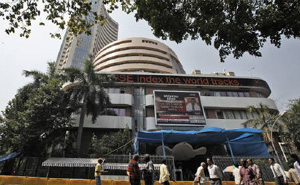
Showing posts with label Sensex. Show all posts

Wednesday, March 23, 2011

Sensex moves northward on fresh buying

Mumbai: The BSE benchmark Sensex shrugged off initial losses and was up by 165 points in early trade Wednesday on the back of renewed buying in banking, FMCG, healthcare and metal stocks.

The Sensex, which shed 16.26 points at the onset of trade, bounced back to trade higher by 172.75 points, or 0.96 percent, at 18,161.05 at 1000 hrs.

Similarly, the broad-based National Stock Exchange index Nifty rose by 57.75 points, or 1.06 percent, to 5,471.60.

Brokers said a recovery in financial, healthcare and metal sector stocks helped the Sensex trade notably higher.

The BSE banking index rose by 1.40 per cent to 12,407.95, with the country's largest lender State Bank of India gaining 0.43 percent to Rs 2,632.10, while private lender ICICI Bank rose by 2.26 percent to Rs 1,026.

Shares of health care companies were also in better form after the government decided to roll back 5 percent service tax imposed on private hospitals with 25-bed or more capacity.

The healthcare index was up by 1.08 percent at 5,922.35 at 1000 hours, with stocks of Fortis Healthcare rising by 0.13 percent to Rs 151.50 and Piramal Healthcare up by 1.55 percent at Rs 478.80.

Sugar sector stocks also evoked good buying support after the government allowed sugar export of up to 5 lakh tonnes.

Among the Sensex pack, 16 stocks advanced, while the rest declined. Hero Honda Motors (up 1.11 percent) and Jindal Steel and Power (up 1.03 per cent) gained in the early trade.

In contrast, Mahindra & Mahindra (down 1.46 percent), and TCS (down 0.66 percent) were among the prominent losers.

Meanwhile, Japanese shares dropped in early trade Wednesday, surrendering a portion of Tuesday's large gains, with the aftermath of the March 11 earthquake still weighing on some shares.

The Nikkei 225 average was down 1.21 per cent, though most other Asian shares rose. Key benchmark indices in Singapore, South Korea, Taiwan and China rose between 0.12 percent and 0.78 percent. Hong Kong's Hang Seng, however, fell by 0.21 percent.

Friday, March 11, 2011

Sensex extends losses, down by over 127 points on funds selling

Mumbai: The Bombay Stock Exchange benchmark Sensex fell by over 127 points in opening trade Friday on continued selling by foreign funds amid a subdued trend in global markets over weak US economic data and unrest in Saudi Arabia.

The 30-share barometer, which lost 141.97 points in the previous session, lost another 127.61 points, or 0.69 percent, to 18,200.37 points on Friday, with metals, IT and capital goods stocks leading the fall.

In a similar fashion, the wide-based National Stock Exchange Nifty index moved down 43.80 points, or 0.79 percent, to 5,450.60 points.

The trading sentiment remained bearish on the back of a weakening trend on other Asian bourses due to unrest in Saudi Arabia and overnight losses in the US market due to weak economic data, brokers said.

They said a cautious approach adopted by participants ahead of the release of IIP data for the month of January later today also influenced the sentiment.

Meanwhile, in the Asia region, Hong Kong's Hang Seng index was down by 0.67 per cent and Japan's Nikkei by 1.3 percent in early trade this morning. 

In the US, the Dow Jones Industrial Average ended 1.87 per cent lower yesterday.

Wednesday, February 16, 2011

Markets see a quiet start

Markets saw another quiet opening today, on cues from US and Asian markets. The Sensex opened at 18,273. The index slipped into red to a low of 18,238before recovering and touching a high of 18,349.The Sensex up 40 points at 18,315. 

Nifty was up eight points at 5,488.

US markets slumped the most in over two-weeks as a lower-than-expected retail sales data for January dampened investor sentiments. Dow slipped 42 points to 12,227. Nasdaq dropped 13 points to 2,804. 

Asian markets were trading on a mixed note. Hang Seng shed 61 points to 22,838. Meanwhile, Nikkei was up 41 points at 10,788. Te Japanese markets, gaining for the third straight day, crossed the 10,800 mark after nine months.

Indian markets on Tuesday ended a choppy session of trade in the green led by gains in banking and oil & gas shares. The Sensex ended up 72 points, at 18,273. The Nikkei closed at 5481, up 25 points.

Tata Steel would be a stock to watch out for as it reported a two-fold rise in net on Tuesday. The company posted a profit after tax of Rs 1,003 crore for the third quarter ended December 31, 2010, compared with Rs 472.65 crore in the same period last year. The stock is up 2.5% at Rs 632.

Most of the sectoral indices are in the green, barring realty and auto. Realty index has dropped 1% in opening trades.

Metal index has gained over 1% at the same time. The index is at 15,963, helped mostly by Tata Steel.

DLF shed 2% at Rs 235. HDFC slipped 1.6% to Rs 636. 

Tata Motors and Reliance Communications, BHEL, ICICI Bank, HDFC Bank were in red.

On the other hand, Jindal Steel, Larsen & Toubro and Sterlite gained 1-2% each.

Other gainers include Hero Honda, Jaiprakash Associates, Bharti Airtel, Reliance Industries and SBI.

Source:-http://www.business-standard.com/india/news/markets-seequiet-start/125884/on

Tuesday, February 8, 2011

Bulls beat the retreat


After a heady 2010, the bulls are on the backfoot in the New Year and the bears are on the prowl. Consider this: the Sensex soared 3,000 points in 2010 as foreign institutional investors, or FIIs, captivated by the India shining story, pumped in a record $29.4 billion into the equity markets. India will remain a good long-term bet, chorused the bulls. But a few weeks into 2011 and a palpable sense of gloom has descended on Dalal Street. The Sensex had shed 2,113 points in 2011 at the time of going to press and the FIIs have turned net sellers.

And traders are fretting that the markets may remain tentative awhile. So what is worrying the bulls? Most say the total paralysis of governance in New Delhi followed by the recent spate in corruption scandals have soured market sentiment. "Corruption and scandals are factors that are negatively affecting valuations and increasing the risk premium attached to investing in India," says Boston-based Punita Kumar Sinha, Senior Managing Director at Blackstone Asia Advisors, an FII investing in India. Global investors are typically very sensitive to governance issues in emerging economies.

"For any emerging economy, it is important to have a good governance record in order to pre-empt possible adverse reactions from international investors," says Siddhartha Sanyal, Chief India Economist at Barclays Capital.

Hong Kong-based Adrian Mowat, Chief Asian and Emerging Market Equity Strategist at JP Morgan, seconds Sanyal. The second half of 2010 was marred by scams, and Parliament's failure to pass any legislation, says Mowat, has gradually taken its toll on market sentiment. He hopes Parliament is allowed to conduct business during the Budget session. "If it does then political sentiment will improve. The prosecution of high-profile people accused of corruption will also improve confidence. Sadly, the expectation is that it will not happen," he says.
Punita
Punita Kumar Sinha, Senior Managing Director, Blackstone Asia Advisors
The government's hands may also be tied with Assembly elections in five states slated for 2011, worry analysts. "There could be some political compulsions," says Parul Saini, Executive Director at Singapore-based RBS Asia Securities. With the Assembly elections and the ongoing political stalemate around corruption, the Street does not expect progress on any politically sensitive reforms. "Given the upcoming elections in various states, it is possible that the Budget will continue to spend on subsidies," says Sinha.

Macroeconomic concerns are adding to the woes of the bulls. Galloping food inflation and hardening interest rates could derail the Indian economy in the short- to medium-term is the consensus in dealing rooms. The fears may not be entirely unjustified. On January 25, after announcing a 25 basis point (100 basis points make a percentage point) hike in repo and reverse repo rates, D. Subbarao, Governor, Reserve Bank of India, or RBI, stressed the dangers of "food and fuel price increases spilling over into generalised inflation". He added: "There has been a sharp rise in global commodity prices, which has heightened upside risks to domestic inflation."

The RBI has raised its inflation projection for March 2011 from 5.5 per cent to 7 per cent. "The inflation fears are justified," says Mowat. The prices of oil, agricultural products and metals are up 17 per cent, 16 per cent and 10 per cent, respectively, over the past three months, which, Mowat points out, is a threat to growth. "Oil exceeding $100 a barrel could be another negative for investors and overall business confidence," he says.

All the negative news could potentially take its toll on FII flows. So, could we see outflows from India? "We are expecting a slowdown but not a reversal," says Saini. According to him, it may be hard to replicate last year's situation. "As the economic recovery in the US takes hold, investor funds may flow back into equities there at the expense of emerging markets," he adds.

Agrees Sinha: "Clearly, there is a rotation happening. If the US economy continues to show signs of improvement, then some of the allocation could move out of emerging economies, including India." Developed markets, then, could outperform emerging markets such as India this year. "Developed markets are enjoying a cyclical lift, which for now seems more important than their still-serious structural issues," says Mowat.

This is bad news for Indian companies as their plans to raise capital from the primary market could be hit. Last year saw the highest ever mop-up of public issuance by Indian corporates worth about Rs 59,523 crore. In 2011, there are 100 public issues in the pipeline for the private sector alone. "The indicative IPO size from these public issuances is about Rs 50,000 crore," says a report from New Delhi-based SMC Global Securities, a brokerage firm. The government's $10-billion PSU divestment programme will also be impacted. "A slowdown in foreign flows does make a divestment process more difficult," says Saini.

Given the headwinds, then, expect the markets to remain edgy and nervous in the short term. But for the long-term investor, the rules of the game remain the same, say analysts. Every dip is an opportunity to accumulate quality stocks.

Monday, February 7, 2011

Rupee gains 4 paise against dollar in early trade


Rupee gains 4 paise against dollar
The Indian rupee rose 4 paise to Rs 45.55 against the US dollar in early trade at the Interbank Foreign Exchange on Monday.

The rupee had closed marginally higher by 2 paise at Rs 45.59/60 per dollar in the previous session. Dealers said a firm opening in the equity market and dollar weakness against the euro supported the Indian currency's sentiment.

The Bombay Stock Exchange benchmark Sensex recovered by 126.87 points to 18,135.02 in early trade on Monday.

Source:-http://businesstoday.intoday.in/bt/story/rupee-gains-4-paise-against-dollar-in-early-trade/1/13005.html

Thursday, January 20, 2011

Eight Indian MFs in World's 25 best funds in a decade

Eight domestic equity mutual fund schemes, including SBI Magnum Contra , HDFC Equity and Reliance Growth , are among the 25 best-performing open-ended equity funds in the world of the last decade, according to investment research firm Morningstar. These funds benefited from the 10-fold growth in total value of India's stock markets, led by a robust performance of one of the fastest growing economies in the world.

The eight funds returned 31% to 38% on a compounded basis in the past decade. The Sensex returned 17.8% on a compounded basis during the 10 years. Russia's RTS fetched 28.6% and Indonesia's JSX Composite gave 24.4% returns during the period.

Twelve equity mutual fund schemes from India figure among the 25 best-performing open-ended equity funds in the world over 15 years, Morningstar said in a note.

"Russian and Indonesian stock markets have performed better than ours in the last 10 and 15 years, but Indian equity funds crowd the list because the other countries did not have enough funds to capture those returns," said Dhruva Raj Chatterji, senior research analyst, Morningstar India.

India's total stock market capitalisation grew to over $1.6 trillion in December 2010 from $148 billion early last decade.

But no Indian fund made it to the list of best performing funds in the last five years or in 2010. China-focussed funds swamped the list for the top-25 performers during the last five years.

The Sensex fetched 16.9% returns in the five years to December 2010 and 17.4% in 2010. China's Shanghai composite rose 19.3% in the five years ending December 2010; in 2010 it had fallen 14.3% .

The worst performing market in 2010 within Asia was China, whose benchmark Shanghai Composite index closed in the red, falling by more than 14% after registering an 80% gain in 2009, the Morningstar note said.

"Concerns over monetary tightening, measures taken by the government to curb assets bubbles, including in the real estate market, and capital diversion to the huge number of IPOs weighed down on the performance of the benchmark index. This was despite the country's economy continuing to soar during the year," it said

Subscribe to Extraminds feeds

NDTV News - Top Stories

Latest Happenings all around the world Headline Animator