Showing posts with label CEO. Show all posts

Thursday, March 24, 2011

Life's about planting trees for others: Warren Buffett

BANGALORE: On the second day of his India trip on Wednesday, Warren Buffett was a busy man, having a brief chat with the Karnataka CM before a factory visit to the only Buffett investment in India, TaeguTec India, a high-end tooling company. After pounding the shop floor, addressing employees and planting a sapling, it was time for a meeting with city CEOs. Before leaving for Delhi, the 'Sage of Omaha' spoke exclusively to TOI. Excerpts. 
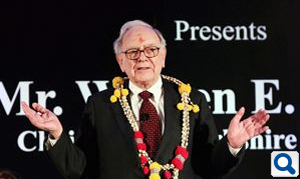
Q. We noticed that when you were planting the tree, there was a different Warren Buffett, different from the persona of an investor or a philanthropist. You seemed to open up in a different way. 

A. Well, I like to think that I open up even otherwise (laughs). But part of life is to plant trees that other people will sit under. Somebody planted a tree for me long ago in the form of an educational institution and I sat under that tree, metaphorically. The same happened in one area after another in my life. 

Q. The chairman of Infosys, Narayana Murthy, talks of compassionate capitalism. Is philanthropy going to be the compassionate side of capitalism? 

A. I think philanthropy should be part of humanity. I don't relate it to capitalism or to business. When you have everything that you possibly could need yourself and other people need what you have that is of no use to you and has enormous use to them, I think you need to do something about it. 

Q. Philanthropy till now largely has been an individual effort. As it becomes bigger, it might become an institutional effort with its own systems, processes, checks and balances. Will it take away from the spontaneity of the individual effort that it is today? 

A. No, I don't think so. What we are encouraging is more individual effort. We are not asking people to join us or to give to what we believe in. We are encouraging people to enjoy giving and do it their own way. They can do it when they want, with whom they want. Maybe they can learn from each other. I have learnt from other people I have met. It's not designed to centralize anything. It's designed to encourage people individually and in their families to do the things we found so enjoyable. 

Q. In India, the greatest potential is in the infrastructure sector. Would you be looking at gas, power, steel, utilities in general for investment? You did say on Tuesday that you would look at making one big investment a year in India. 

A. I would like to make a big one, but it will have to be in a field that I understand. A company in which I have a good feeling about where it will be in 5/10 years, competitively. 

Q. From what we have read, gut instinct plays a large role in your investment decisions. Many investors like to kick the tiles, go to the shop floor to see if an investment makes sense. Are you that kind of an investor? 

A. No, I look at the people who run it. I would not know what to do if tomorrow morning you make me in charge of a plant (laughs). But I do know who should be in charge of it. 

Q. Your only investment in India so far is in Bangalore-based TaeguTec. Would you future investments here be in such specialist, high-end manufacturing companies? 

A. These kind of companies will do very well. But there are a whole group of companies that will do well in India. So, I will not limit my interest to something like this.

Wednesday, February 23, 2011

Ruia Group acquires German automotive fastener firm, Acument GmbH

Kolkata: The Ruia Group has acquired Germany-based automotive fasteners manufacturer, Acument GmH & Co KG, from US-based Acument Global Technologies Inc. With the acquisition of Acument's plants in Neuss, Beckingen, Neuwied and Schorzberg and its logistic centre in Koln in Germany, the Ruia Group has incorporated a new company - Ruia Global Fasteners AG (RGF).

According to Pawan K. Ruia, chairman of the Ruia Group, the group would invest approximately 4 million Euro in the company. He expects the company's turnover to be around 200 million Euro this year.

The acquisition was funded partly by internal accruals and rest was by three years sellers' credit.

Acument GmH & Co had a turnover of 227 million Euro in 2010. In 2008 following the global economic meltdown the company incurred a loss of 40 million Euro. Due to this Acument's board of directors had filed for insolvency in 2009. The company had posted a turnover of 800 million Euro before insolvency.

Robin Kendrick, former Vice President and General Manager of Acument Europe is now president and CEO of Ruia Global Fasteners Ltd.

The company has a 15 percent of market share in the fastener segment in Europe.

Pawan K. Ruia said that he had no intentions of shifting the operations to India. However, based on demand, the group may decide to locate additional manufacturing units in India.

This acquisition is expected to help the company tap opportunities during the next boom in the automotive market, which is projected to grow five times in India by 2020.

The Ruia Group had acquired Schlegel Automotive Europe Ltd in 2008, Draftex Automotive GmbH in 2009 and Gumasol Rubber Tec GmBH in 2010. This is the group's third acquisition in Germany.

This year the group is targeting a turnover of 335 million Euro (20.534 billion Indian rupees), of which 50 percent is contributed by it's overseas operations.

Source:-http://machinist.in/index.php?option=com_content&task=view&id=3101&Itemid=1

Saturday, February 19, 2011

Essar Energy set to acquire Shell refinery for $350 mn

Essar Energy on Friday announced that it has entered into an exclusive agreement with Shell UK for the proposed purchase of an oil refinery and other associated assets at Stanlow, near Ellesmere Port in Cheshire, for $350 million in cash.

The deal brings Essar Energy and Shell to the penultimate stage of two-year negotiations that also saw a brief hiatus last year, only to be revived after Essar Energy completed its $1.3-billion IPO and subsequent listing on the London Stock Exchange.

The deal will be the third largest by an Indian group in the UK, following Tata’s acquisition of Corus ($8.1 billion in 2006) and Jaguar Land Rover ($2.3 billion in 2008).

Successful conclusion of the deal, even at the current capacity utilisation of around 75 per cent, should give Essar an additional $7-8 billion in revenues at current crude prices, said Essar Group CEO Prashant Ruia, in a telephone interview from Mumbai.

He said the company would continue to keep its strategies open for further acquisitions in the oil sector, provided there is a clear fit in its scheme of operations.

According to the new deal, Shell has granted Essar Energy exclusivity to the acquisition until April 1, 2011. Essar Energy has the option until March 31, 2011 to enter into an asset purchase agreement.

If by that date Essar Energy decides not to proceed with the acquisition, it will pay Shell a break fee of $50 million. Similarly, Shell has agreed to pay Essar Energy a break fee of $10 million if it chooses not to go ahead with the sale.

In a statement issued here, Essar said that the acquisition of the Stanlow refinery, which is the second-largest in the UK, will give it direct access to the UK market. Naresh Nayyar, Essar Energy's chief executive, said, “Stanlow fits very well with our strategy of providing options for the export of high-quality products from our Vadinar refinery in India. After completion, we look forward to working closely with the refinery management and employees to develop the business and we will be investing in operational improvements to optimise the facility and enhance production.”

Essar Energy said it is acquiring the Stanlow refinery at a competitive price, compared with other recent similar transactions. The price of $350 million for the 296,000-barrels-a-day plant translates to $1,182 a barrel of daily throughput, compared with BP’s Coryton refinery sold in 2007 to Petroplus for $8,140 a barrel, Total’s Milford Haven refinery sold to Murphy Oil in 2007 for $3,307 a barrel, PDVSA’s Ruhr Oel refinery in Germany sold to Rosneft in 2010 for $3,376 a barrel and Total’s Vlissingen refinery in the Netherlands sold to Lukoil in 2009 for $8,439 a barrel.

With the completion of the acquisition, Essar will also take on board 960 workers at Shell’s Stanlow refinery. In the first six months of 2010, the facility reported earnings before interest, tax, depreciation and amortisation (Ebitda) of $62.7 million and a gross refining margin of $4.90 a barrel.

Average industry benchmark gross refining margins were $2.73 a barrel in the first half of 2010.

Under the terms of the agreement, payment for the Stanlow refinery will be made in two stages, with $175 million payable on completion of the acquisition and a deferred payment of $175 million plus interest payable on the date of the first anniversary of the completion of the acquisition. Payments from Essar Energy to Shell for the acquisition will be funded from existing cash resources and potentially from a new debt facility.

The Stanlow refinery currently accounts for around 15 per cent of production from UK refineries. It produces approximately 3.5 billion litre of petrol a year, which is one sixth of the UK total, plus it produces around 1.5 billion litre of kerosene a year, used for aircraft fuel.

Deal size could touch $1.3 billion

There was some confusion about the actual size of the proposed Essar Energy-Shell deal for the Stanlow refinery in the UK. While Essar said it was paying $350 million, the Shell website stated, “Shell on Friday confirmed it has received an offer from Essar Energy to buy its 272,000 barrel-per-day Stanlow refinery and associated local marketing businesses in the UK for a total expected consideration of some $1.3 billion.”

Frantic calls between Mumbai and London helped clarify that the deal size is in fact only $350 million, which is the price Essar will be paying for the refinery assets. The balance, which Shell at this stage believes to be $900 million, is for the inventory lying on site, including crude, work in progress and finished products. “You don’t expect us to buy a working refinery drained of its inventory, do you,” asked a senior Essar executive in Mumbai.

A Shell spokesperson here later confirmed that the $1.3 billion it is claiming to be the deal size includes the inventory along with the refinery assets that Essar plans to buy. “Beyond this, I cannot say anything,” said the spokesperson.

Successful conclusion of the deal will be subject to employee consultation, in which both Essar and Shell will participate

Thursday, February 10, 2011

Indian-origin man stalking Facebook founder

Facebook founder Mark Zuckerberg [ Images ] has obtained a restraining order against an Indian-origin man, who was allegedly stalking the billionaire CEO and his family and asking for financial assistance for his ailing mother.

In the restraining order, a judge has ordered Pradeep Manukonda, 31, to remain at least 300 feet away from Zuckerberg, his sister Randi Zuckerberg and girlfriend Priscilla Chan.

Zuckerberg had claimed in legal papers filed with the court that Manukonda tried to "follow, surveil and contact him using language threatening his personal safety and the safety of his girlfriend and sister" .

In letters and messages on Facebook to Zuckerberg and his sister, Manukonda said his family is going through financial hardship and he was looking to them for help.

In one such letter, Manukonda said his mother is suffering from a serious illness with little time to live. He said he is not asking for "charity or donations" and promised Zuckerberg he would "repay the entire amount incurred for her treatment".

In another message, Manukonda, who also goes by the name Pradeep Kumar said, "I am completely tired and exhausted. Please Mark time is really running out for me. I really need your help. Please respond in time before it get too late for us".

He further writes, "I owe my entire life at your service, please help me, then I am ready to die for you" and "please understand my pain, please understand my situation".

Manukonda also wrote to Zuckerberg's sister, who is Facebook's director of market development. His message to her read, "Dear Randi please respond, before its get too late. I am sorry to bother you, which is not at all concern to you, every second is precious to me. Please understand the urgency and do the needful thing. I really need your help. My dear sister thanks (sic)".

Manukonda reportedly apologised for his behaviour saying, "I'm a peaceful guy. I'm sorry he (Zuckerberg) thought I was trying to harm him," Manukonda told celebrity news website TMZ.

"I understand he's a busy man. I'll respect his privacy". He said he had been dealing with "a major personal problem" and thought Zuckerberg could give him some advice.

Manukonda had also gone to Zuckerberg's home in late January and reportedly showed up at his office in Palo Alto [ Images ], the website said.

Local police had issued a verbal warning to Manukonda after security guards found him attempting to walk up the front steps of Zuckerberg's home on January 24.

He had allegedly also sent flowers and a handwritten letter to the Facebook founder's home on January 28. A court hearing on the stalking allegations is set for February 22.

While Manukonda has not been arrested, if charged with stalking, he could face up to one year in jail and or $1,000 in fine.

Image: Facebook founder Mark Zuckerberg


Source: Indian-origin man stalking Facebook founder - Rediff.com India News

Subscribe to Extraminds feeds

NDTV News - Top Stories

Latest Happenings all around the world Headline Animator